
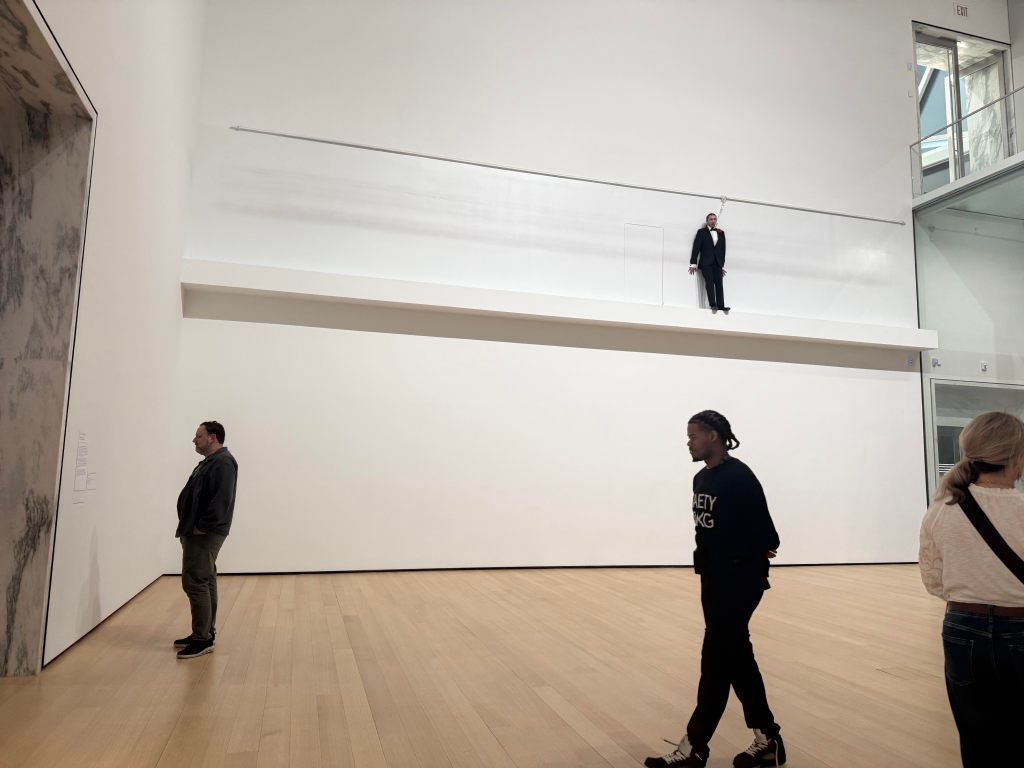
In both birding and art museums, a crowd means something’s interesting. So when there was a tightly packed row of people looking over the edge of the walkway, I looked too.
My trip to the Buffalo AKG Art Museum was a pilgrimage between errands – my teenage daughter was meeting friends on this of the city and it was too far away to drive home. I had time. It was also First Friday, meaning my admission was as inexpensive as my integrity would allow. I wanted to have different thoughts in my head than those which typically crowd it. I’m in that phase of life where routines are steady like iron porch supports. It feels like my emotional valence could be captured by the Nine Inch Nails single “Every Day Is Exactly The Same” despite how my days are filled with distinct tasks and different events.
So I was there, staring. Against the wall that’s perpendicular to the mezzainine we were standing on, was a figure tethered to a row anchor on a ledge halfway up the wall. A ledge? Has that ledge always been there? I mistook the situation for an animatronic person on a wire – after all, I am used to seeing the fantastic and the fake. I looked more closely and realized that he was a real person in a tuxedo, shuffling from one side of the ledge to the other, back and forth, not like a clock pendulum because his movements were jerky, as if he were anxious.
Prior to my arrival at the AKG, I had flipped through Buffalo-area writer, conceptual artist, poet, and restaurateur Kevin Thurston’s* most recent chapbook, Slogans 1. In it, among other ideas, Thurston declares the Buffalo AKG Art Museum an “aesthetic rat trap”. The words “Aesthetic rat trap.” are overlaid over one of the promotional renderings of the new Gundlach building. It is a picture no longer on the page that Google directs you to. Someone not of Buffalo might miss the reference. Those of us in Buffalo catch a whiff of sacrilege. Thurston’s work routinely challenges the virtuosity that is presented by default to whatever is normative and powerful. (See “Civics Test” or Color Me White with the late Mickey Harmon). As is the case with all of his postulations in the chapbook, it is launched defenselessly into our consciousness. Thurston will not clutter the page with justifications for his ideas, or explanations of his meanings.
Rat traps mitigate infestation to improve the quality of life for creatures that are not rats. To liken an art museum to a rat trap could argue that it is improving the quality of existence for that which is not art. We get to enjoy art. Most of the museum’s collection is stored away from the public eye in an unlabeled, nondescript warehouse in Black Rock that seamlessly blends in with the grit of its surroundings. It is, presumably, a place a darkness and dryness, permitting art to exist as long as possible by protecting it from being touched and illuminated. Rat traps are violent – a way that we dole death to that which we deem not justifiable in its existence. Does Thurston intend to mean that the AKG is a form of death to the aesthetic within?
Is it simply a reference to how some humane rat traps have a similar cage-like pattern that the windows of the Gundlach building have? One voluntarily enters, lured by something attractive, and find yourself in a different place when you leave? That was the mental experience I was hoping to have.
Rat trap or not, I was standing inside of it nonetheless. The AKG has mostly pictures, sculptures, and videos. To have someone alive and performing is rarer for the times when I am most likely to be present. I watched this man for awhile, unable to maintain that fourth wall where I’m supposed to consider the ideas of the performance, and not just that I am watching a dude who showed up for work at his unusual job. I usually wonder about the lives of waitresses and clerks I meet too – I often can’t see past the people in front of me. I wonder how much of the anxiety coming off of him is real and how much is performance. I wonder if he’s OK. The tips of his shoes persistently peeked over the edge. I wondered if a world without OSHA would be a world where he was sans tether.
The man was part of “Bangemand/Scaredman” – a performance piece, where a man in a tuxedo reenacts a scene from movies where the hero has to tiptoe on a ledge in order to be victorious in whatever endeavor they are doing. At least that’s what the description said – I don’t really watch movies. It is meant to reflect on power, masculinity, fear, stuff like that. It looks like the original may not have had the tether. The photo from the AKG’s press section suggests the wall hadn’t turned gray from the constant back and forth, the dye of the suit rubbing off on the paint, or maybe the metal of the tether leaving a mark. I wonder if there is a bruise on the backs of the performers from its pressure.
It is part of the exhibition “Politics of the Obvious,” featuring the works of Ragnar Kjartansson at the Buffalo AKG. I was not able to spend time with most of them because after I walked into the main video area I received a text – my teenage daughter needed to be picked up – my time at the museum briefer than planned.
But not yet here. I went downstairs and stood on the floor in front of the ledge, watching him for maybe five minutes. Back and forth, back and forth. It felt more tedious than thrilling, more like terrible working conditions than inspiring. The tether of safety to keep him from doing anything besides back and forth, back and forth, felt like a better metaphor for my experience of midlife than it did commentary on masculinity (of which, notably, I have scant lived experience). The fact there are wildly dangerous consequences from jumping off feels like a metaphor for midlife too. That people do, despite this, pursuing what feels like freedom? The traps of midlife are often simply the inescapable consequences of one’s actions and choices.
Back and forth. Back and forth. Shuffling, side to side, never one foot in front of the other. I wondered what the casting call looked like. “Man, will wear a tuxedo, must be able to tolerate monotony and heights.” I imagined the actors (there was more than one) clocking out of work and stumbling into one of the bars on Elmwood Ave. The person next to them asks what they do for work. “I am an actor. In my most recent performance, I shuffle back and forth while people watch.” What does that employee performance review look like?
Why have someone perform a movie cliche in front of people? Why put someone on a ledge unnecessarily (is art necessary?) on a Friday night?
Sometimes art feels like a relic from a preinternet time, when we communicated ideas through creation instead of the avalanche of words, everywhere. Art endures, and I think may become more robust, as the forums where words flow start to become saturated in bulk-generated sentences of machines pretending to be human, meant for humans, but hollow. I say this as someone whose creative medium is words. How do we know what’s real except what is in our hands, in our physical word?
Be it Thurston’s chapbook or an international exhibition, the question that helps me consider art continues to be the same question I ask when someone misbehaves: Why did they do that?
In all cases, I walk away with a head full of ideas and empty of certainty. It hands me yet another lens to look at what I routine see. I need the novelty for both creativity and persistence. And so, I seek out art.
*In true Buffalo fashion, I know him. He is a subscriber. Hi, Kevin!


Leave a Reply